Rise Up Joyful

When I rise up
let me rise up joyful
like a bird.

–Wendell Berry, “Prayers and Sayings of the Mad Farmer”

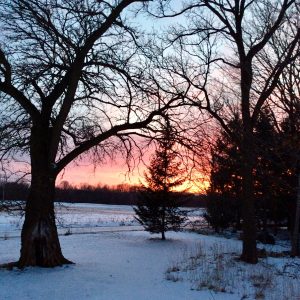
With March arriving, birds on the farm begin to rise. Many lived here all winter, of course, flocking to our feeders in the ice and snow. I keep a list of the ones I see: Nuthatches, titmice, chickadees, and slate-eyed juncos. Goldfinches and house finches. Hairy woodpeckers, downy woodpeckers, common flickers. Bossy blue jays. Vibrant cardinals. Others don’t come to the feeders but fly around the farm nevertheless. Red-tailed hawks soaring above the frozen fields. The clutch of crows perched in the spruce trees croaking back and forth to each other each morning. The great horned owl hoot-hoot-hooting somewhere overhead in the cold, still night.

Just last week, I discovered an eastern screech owl had taken up residence in our barn’s loft sometime this winter. I noticed first that the floor was littered with these weird soft gray oblong masses: owl pellets, I realized. And where there are owl pellets, there must be an owl. So I searched up in the rafters, and there it was, perched high in the peak of the barn, eyeing me warily. I have been trying to attract owls to live on the farm for a while now, so I was happy to greet it.

These year-round residents are now joined by others. Last week, as I was beginning the greenhouse work, I saw the season’s first red-winged blackbird, right on cue. This morning I heard the eerie trumpeting of a sandhill crane and stepped outside just in time to see it drift low over the roof of the farmhouse and north toward the woods abutting the back of our property. We should be seeing robins soon, followed by bluebirds and orioles. And then my favorites, the tree swallows, which will fill the warm evening air, falling and rising above mid-summer fields.
Think Of It As a Quickening

We rise, we rise, we rise toward spring. Day by day, the light gains. Under its frozen crust, the world wakes. Winter may still have its icy hold on us, but if you look and listen carefully, spring stirs.

Recently I came across a phrase I think describes well this in-between time: that winter is pregnant with summer. Now is a season of expectancy, anticipation, and, above all, preparation.

Think of it as a quickening, if you like, when one feels the first kicks of new life. And it’s almost impossible to talk about new life without invoking seeds. In truth, much of my farming activity this time of year centers on my preparing to sow seeds.

First, in December, I review the farm’s seeding schedule, a long spreadsheet that throughout the season tells me what to sow, and when, and in what quantities. I base any revisions on my notes from the previous season’s experiences, adjusting quantities and timings as needed.

What kinds of evaluations am I making? Sometimes a variety doesn’t perform as well as I would like. For example, the Cherokee Purple tomato, while great tasting, is too prone to cracking in our fields, so I was happy to discover the Carbon tomato, which has performed much better for us. Sometimes new varieties become available that improve on the older ones. Broccoli, for some reason, seems prone to this churn, and each year I need to revise my schedule to reflect these new varieties.

Sometimes I am forced make substitutions because certain varieties are no longer available. This year, for whatever reason, I can’t seem to get the Provider bush bean through my usual sources, so I will be growing Strike, which, fortunately, is just as good. And sometimes I just decide to try something new and different, like how I got it in my head this year to grow a bunch of French heirloom vegetables, just for the fun of it.

Once the schedule is finalized, or nearly so, I place my seed order. In the past, I have aimed to do this task done sometime in January, but the demand for seeds has been so high during these pandemic years, I made sure it was done earlier, no later than mid-December, to avoid any shortages.

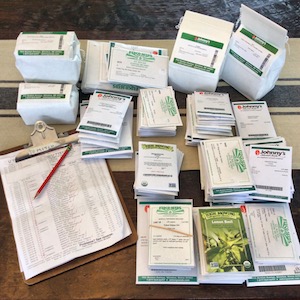
When the seeds arrive, I check the packing slips to make sure I have everything I ordered, then sort the seeds according to family and stow them in airtight containers to keep them safe until I need them later in the spring.

But I need more than seeds. I also need soil to sow them in, and pots and nursery flats to put the soil it, and these also are secured this time of year and stowed safely in the barn.

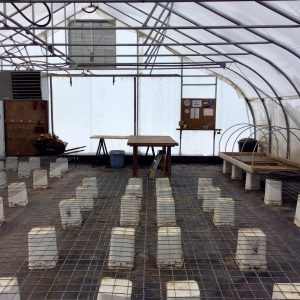
And I will need someplace to put all those sown pots and flats, as well as an orderly place to work, so I make sure that all in the greenhouse is ready, too. I clean it if it wasn’t cleaned in the fall, check to make sure the air circulation fans and louver vents and, most importantly, the heater are all working properly. I see to it that the propane tank is topped off, and I make sure all my greenhouse tools are in good order.

Then, when the page of the calendar turns to March, I will enter that greenhouse, fire up the heater, dial up John Coltrane’s Love Supreme on the iPod, say a prayer, and get down to work.

What Sets Us Apart

When I started growing vegetables over fifteen years ago, as a hired hand at Trillium Haven Farm, there were only a couple of Community Supported Agriculture (CSA) farms in West Michigan. Since then, that model has so gained in popularity I have lost track of how many there are now. Knowing that there are plenty of CSAs to choose from, we are ever grateful for those of you who have chosen us. But given that many of these CSA farms grow the same vegetable varieties, order from the same seed suppliers, and even use the same brand of potting soil, you might be wondering what sets us apart.

In short: Blackbird Farms is a member-first CSA. Everything we do—every decision we make, every action we take—is focused on delivering the best possible CSA experience to our members.

What does this look like in practice?

First, and most simply, our members are known by name. It is a point of pride that I learn every new member’s name by the end of June, at the latest. And I make sure to be present at every pick-up and greet everyone by name. Not all CSA farmers can do this. Not all CSA farmers even want to do this. But I do, because I believe in reestablishing the connection between people and the place where their food is grown, and you can’t do that when everyone is anonymous.

Second, and similarly, our members are welcome on the farm. While some farmers are not eager to open up their places to “outsiders,” we go out of our way to create opportunities for our members to engage with our farm. Whether participating in the farm work on one of our Thursday evening field parties, attending one of our chamber music concerts in the barn loft, or enjoying an evening potluck and bonfire, we want to share with our members this beautiful place where we get to live and work.

Third, we always place our members before farmers markets (as well as wholesale accounts and restaurants). The danger of a farm having a significant market footprint or extensive restaurant or other wholesale accounts is that there is a profound temptation to siphon off the very best, highest quality, and most popular produce to those outlets, and then leave the CSA members with the leftovers. I have seen this happen with my own eyes at other farms. That will never happen here. We don’t even sell to restaurants, and nothing is sent to our modest farmers’ market stall that isn’t first made available to our members.

Finally, we follow the traditional CSA principle of “share the risk, share the abundance.” This means that, when deciding what goes in any week’s share, I simply tally up what is ready to harvest and then divide by the number of shares. That way, our members share in both the farm’s victories and vicissitudes. I understand that some CSA farms have moved away from this model toward one where the quantity of vegetables their members receive is pre-set, either by some sort of point system or through a prepaid debit card. While this model may be useful to some farmers and appeal to some members, we have decided not to go down this path. Members of such a CSA may have a reduced risk of a poor season, but they also do not get to enjoy the abundance of a good season. What’s more, I worry that such a model transforms members into merely consumers, loosening their personal connection to the farm. And, again, it is my conviction that personal connection is at the heart of what it means to belong to a CSA.

There are many great CSA farmers in West Michigan, and I count it a privilege to have them as my colleagues and friends. It is a good thing that the CSA movement has evolved into different and innovative expressions. And there is no single correct model to suit everyone—you should find a farm that fits who you are and what you believe. But if you crave not only delicious food but also a connection with the people who grow it and the place where it is grown, I invite you to try us out. As I never tire of saying, there is a place at the table waiting for you.

To Do By Them the Best I Am Able

A couple of weeks ago, Socks the feral fighting tomcat appeared on the farmhouse’s front porch, the left side of his face wet with blood. One of his wild adventures must have gone sideways and left him less one eye, and he quietly sat there nursing his injury.

Socks is only the name Shel and I use with each other to refer to him. In truth, he is an unnamed and untamed cat, living at the periphery of the farm, one of a litter birthed just over five years ago by yet another, now dearly departed, farm cat. We would glimpse him from time to time stalking in the margins, occasionally coming onto the farmhouse porch for reasons known only to him.

He is the last of the unfixed cats on the farm. When we moved here nine years ago, we discovered that the previous owners had abandoned their cats when they left, so one of our ongoing projects has been to trap cats, have them neutered, then release them back on the farm. The last round happened a couple of summers ago. We were able to trap nearly all of the unfixed cats—Ninja and Medium, Puffball and Scruffy, maybe more I’ve forgotten about—but Socks remained untrappable. He would approach the trap, sniff the trap, paw the trap, but never enter the trap. I kept at it until winter arrived, when it is advised not to trap and neuter cats, then admitted defeat.

The thing was, though, Socks was a problem. Territorial. Aggressive. The avowed nemesis of our good and gentle farm cat Herbie—in fact, we’re nearly certain Socks is responsible for the couple of infected cat bites for which we needed to take Herbie to the vet over the past year. I knew I needed at least to try again to trap Socks, but other urgencies and emergencies on the farm got in the way.

Then Socks showed up on the porch with his gruesome wound. Poor cat.

Once again, I reached out to my contacts in the West Michigan cat rescue community, and Angela, who has been a great help to us before, replied that if I could trap Socks, she would see that he was cared for through the organization she works with, Heaven Can Wait.

Well, I had been down that trapping road with Socks before, to no effect, but resolved to try again. I set out the live trap that Sunday, and every day that week thereafter. Socks went through his old routine, still wise to the bait. Then, on Saturday evening, after the sun went down and before I disabled the trap for the night, we heard it snap shut. I checked, and Socks was in it, mad as hell, and scared, but trapped. At long last.

I prepared a warm place in the garage for him to spend the night, and the next morning I passed him off to Angela. A couple of days later, she had him examined by a vet. Socks will get his eye socket cleaned up and sown shut, and he has been neutered, and once healed will return to his home, our farm, less one eye but still wild and free.

And, look, I know that this is only a cat. That the world is rife with human suffering, a full measure, pressed down, shaken together and running over. And that the travails of one cat pales in comparison to all of that. But as the farmer I am responsible for all the creatures that call this place home and to do by them the best I am able, every last one. Including even ornery one-eyed fighting tom cats.

(And if you would like to support the good work being done by the folks over at Heaven Can Wait, please do!)

Gathering Seeds

These are the farm’s quiet days. All is dormant, patiently waiting for spring. Any farm work happens indoors at my desk, amid calendars and spreadsheets. And this season’s most important work, and that which gives me the greatest pleasure, is gathering my seeds.

It is a hopeful thing to know that in these frozen and gray days farmers are gathering their seeds, as they have been doing since the dawn of agriculture.

I read in one early-twentieth-century farming memoir how the farmer at harvest time selected the best corn—“bright, uniform, well-filled ears with straight rows”—and stashed it, like golden treasure, in a secure storeroom upon a custom wooden rack. Sometime in February, he prised with the tip of a penknife a few kernels from each ear, then germinated them in a box partially filled with earth and covered with muslin, labeling each seed to keep track of which ears they came from. After the seeds had sprouted, showing which would grow strongly and which poorly, he laid aside the weaker and sterile ears and shelled the good ears for that spring’s seed corn.

I don’t do anything like that. I get all my seeds in the mail from seed companies. Still, I like knowing that when I spread those little paper packets on my dining room table, cross-checking the packing slips and organizing by kind, I join all those old farmers in this yearly ritual.

I ordered my seeds from four companies this year: Fedco Seeds, an old reliable standby with a delightfully quirky catalog and a generous discount policy; Johnny’s Selected Seeds, which caters to the smaller-scale grower and offers many excellent varieties that work well for this kind of farm; High Mowing Seeds for certified-organic seeds, which we are required to use when available; and the Seed Savers Exchange for heirloom varieties to add a dash of color and uniqueness to our vegetable offerings.

And this year I ordered them earlier than usual, back in December, to sidestep the now typical pandemic-related supply chain disruptions. A couple of weeks later, brown boxes and padded envelopes began arriving, all the coming season’s potential bounty, courtesy of FedEx, UPS, and the United States Postal Service.

Seeds are such commonplace things, and yet also magical, these little nuggets of wonder packaged in envelopes and spread across my dining room table. The whole season is contained there, in potential, from the first greenhouse work at the beginning of March to the final harvest sometime in December. Such an inheritance, all those plantsmen and women, all those farmers and gardeners, working and watching, selecting and saving the best, passing it along to the next generation, an unbroken chain anchored in the distant past and stretching out toward the unknown future.

What Else There Is To See

After an unusually mild December, we have now had some proper winter weather. The storm a couple of weeks ago gave us maybe a foot of snow here at the farm, and the fields are still covered in a blanket of white—the farm’s slate wiped clean, marking a clear line between the old season just past and the new one to come.

This weather drives the birds to our feeders, so Herbie the farm cat now spends the balance of his days indoors perched on his chair in the sunroom intently watching what we call the bird show—all the flocking finches, cardinals, nuthatches, chickadees, and slate-eyed juncos. Truth be told, I like the show, too. I hung a feeder just outside the window of the old chicken coop I’ve claimed as a farm office/writing shed, and the birds keep me company while I sit there dreaming and scheming and plotting and planning.

Despite the sometimes unrelenting grayness, January can be one of my favorite months on the farm. Not only a time for looking ahead and beginning the long list of preparations for the coming season, it’s also a chance to expand my perception of what the farm is capable of. Once we hit May, my vision necessarily narrows to the the day-to-day urgencies and emergencies of running a small-scale diversified organic vegetable operation. The long litany of tasks obscures the farm like morning mist.

Winter’s snow clears all that, providing the proverbial blank canvas. So right now there is time and space to think, to engage my imagination. Even though we’ve lived and worked here for almost a decade, I feel like we’ve only scratched the surface of what is possible. And now is the time of year to see what else there is to see.

Before Winter Arrives

What a string of lovely fall days we’ve had. It’s been a gift to have such good weather to wrap up the final few farm jobs that need to happen before winter arrives.

The most important of these was planting the garlic for next season. We had the perfect break in the weather the last week of October, when the soil dried out just enough to plant. And then last week we had a nice warm and sunny day to spread the straw mulch to protect the garlic over the winter. I always breathe easier once I know that those little cloves are tucked away safe and sound, waiting for spring.

With that task crossed off, I have turned my attention to all the end-of-season cleaning and stowing and storing. Making sure everything is put away now is an investment I make in my sanity come spring. And each fall I also make time to plant some things that will make the farm more beautiful the following season and for years to come. This year I did that by planting one hundred crocus bulbs, plus a few stargazer lilies, a task I wrapped up just today.

And each day, the light grows shorter, the temperature drops further, and the farm empties a little bit more. The place is beginning to draw into itself, preparing for the winter cold and snow. As am I.