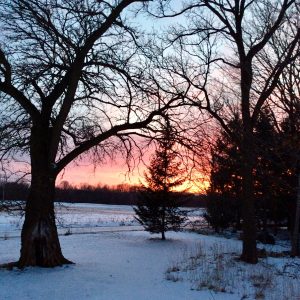
One afternoon last summer, some of Shel’s family came out to the farm for a visit. Her aunt, who is an artist down in Chicago, took some photographs while she was here. I didn’t think anything of it at the time, but, lo and behold, in the deepest, coldest part of last winter, she created some stunning watercolor paintings from those photos. In the frenzy of striving to grow food here, it is easy to lose sight of how beautiful this place is, but these paintings reminded me of my great good fortune to live and work here.
-
Fruition
Just a couple of hours until our first ever CSA pickup, and all is now ready. This week’s share is harvested (it will be small, just a foretaste of all the good things to come this season) and waiting in the cooler. The only things I have left to do are put on a clean shirt, load the truck, and drive into town.
It has been just over two years since we decided to set out on this adventure, and now here we are, growing good food for our families, neighbors, and friends, both new and old. Harvesting this morning, I couldn’t stop grinning, even in the rain. Thankful, is what I am.
-
Progress
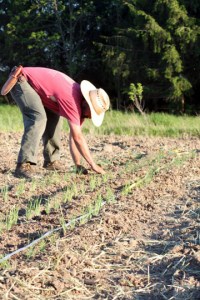
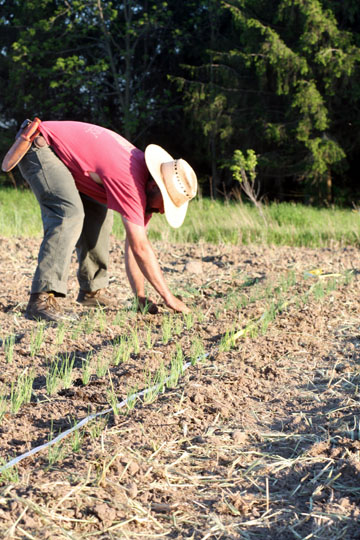
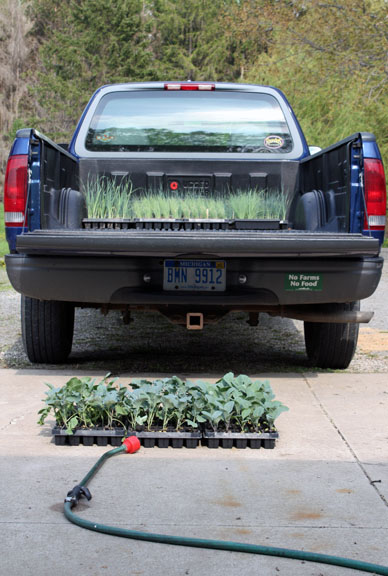
Transplanting Scallions I have been waiting all this cool, wet spring for my soil to dry out, and last week it finally did. The neighbor who discs up my field was able to come over last Wednesday, and Thursday I was out transplanting and seeding, compressing most of the spring’s fieldwork into a few days. As of last night, when I set out my leeks while the sun was setting, I was all caught up: potatoes, scallions, lettuce, celery, celeriac, another round of greens and carrots, even the first round of green beans. This is a great relief to me. Now I move forward into the summer crops. I should be transplanting peppers and eggplants this week, and tomatoes and squash the next. I can’t tell you how good it feels to be moving forward.
-
Forward!
The soil is dry. The weather is good. The plants are ready. Let’s do this thing.
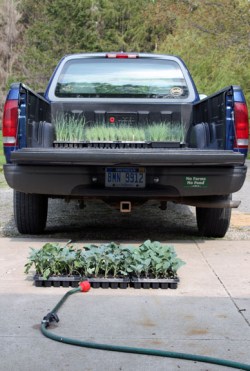
Blackbird Farms vegetable shuttle now departing daily every morning this week. -
Traction
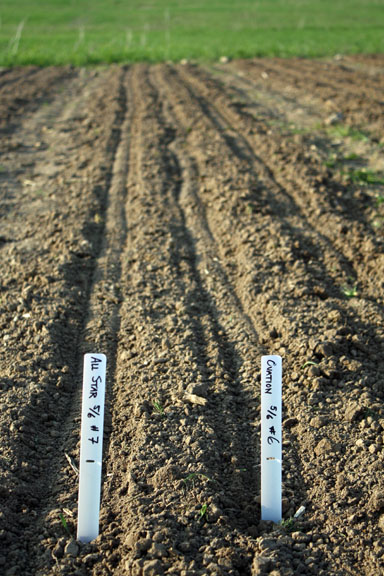
Glory be! Last week, the soil had dried out just enough in a couple of places for me to begin this spring’s fieldwork. Tuesday I prepared enough beds to seed the first successions of beets, carrots, and greens. Then it rained again but dried out enough to begin transplanting over the weekend — onions and shallots, and kale and chard.
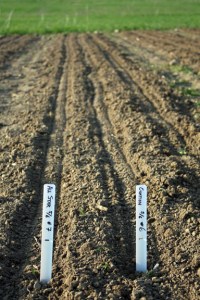 But the season is still behind, I figure by at least ten days. I may have to push back the first CSA pick up by a week, which isn’t unusual. Some years the weather cooperates, and some years it doesn’t.
With all this cool and wet weather, I am learning more and more about how the farm’s soil behaves. The biggest challenge is the layer of hardpan about eight inches under the soil. This hardpan prevents water from seeping through, which saturates the top layer of soil and then pools on the surface. Which is to say, when the soil gets wet, it gets really wet and takes a long time to dry out.
The encouraging thing is to see how much the quality of the soil has improved with even only one year of organic practices. The section of the field I sowed last summer with crimson clover (its deep taproot helps break up compacted soils) now drains more readily and dries out more quickly than the rest of the field. The parts where I broke up the hardpan manually with my digging fork are even better. And with the additions of organic matter I made last year, the earthworms are returning, a good sign of rebounding soil health.
I may not be able to solve this problem overnight, but I am going to solve it.
-
The Grace of the World
A couple of days ago, the little yellow flowers were staring to stress me out, until an orange bird reminded me not to, so I decided to set my Christmas tree on fire instead.
I can see by the look on your face I’m going to have to explain that.
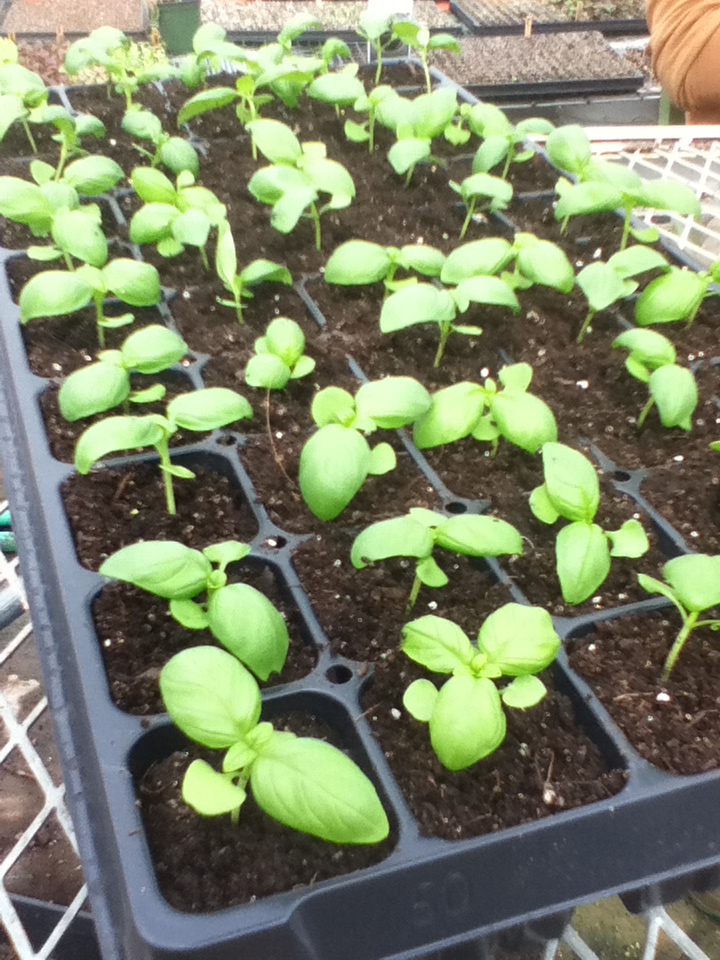
The forsythia and the dandelions are starting to bloom right now, bright yellow flowers spangling the bushes and the yard. For old-time gardeners, the blooming forsythia means it’s time to plant peas, and the dandelions that it’s time to get the potatoes in the ground. As I feared would happen, the fields aren’t drying out as quickly as I want them to, which is starting to back up my planting schedule — not only planting peas and potatoes but also sowing greens, carrots, beets, and parsnips, and transplanting many other things in the greenhouse ready to be set out.
If things don’t dry out soon, there is an excellent chance I will have to postpone the first CSA pick-up by a week. And I really don’t want that to happen.
I was fretting about all this on the porch as the evening drew near, when I saw a flash of orange in the trees. You see, earlier this spring I bought a cheap plastic oriole feeder to see if I could attract any, but all the feeder seemed to draw was ants, and I was starting to think I should throw it out. But, look, here was an oriole, brighter that I imagined, and I was again surprised that nature painted in such vivid colors. And not only the oriole, but also the goldfinches and the dusky-rose house finches, the red-bellied woodpecker and the downy woodpecker, the rose-breasted grosbeak and the indigo bunting. I was reminded of yet another poem of Wendell Berry’s, where he writes of coming into “the peace of wild things who do not tax their lives with forethought of grief,” where he finds “rest in the grace of the world”. And here I am fussing and fretting about something out of my control, when there will be hundreds more such things this season and in every season after that.
So I took a break. I decided I would light a fire after supper, burn some brush and fallen branches and the Christmas tree, which was still hanging around outside. And a burning was appropriate, since this year May fifth is the point midway between the equinox and the solstice, a moment observed in past times to celebrate the immanence of summer, a time to consecrate the fields and the herds, to adorn homes with the small yellow flowers of spring, to light fires for blessing and for protection.
So I set the brush aflame and watched it burn to coals, watched the embers swirl into the clear night sky, watched the half-lit moon pass by the Big Dipper tipped as if to pour spring rains on the earth, watched the farm cat creep out for some nighttime adventure, watched a doe glide through the field to the pond to drink.
And I’d like to tell you that sitting there and watching all this I came to some sort of epiphany, some transformed perspective, but both you and I know most of the time it doesn’t work that way. In the morning the world remains unchanged, with the same old problems and the same old promises, but still with peace and grace for those with eyes to see.
 Blackbird Farms