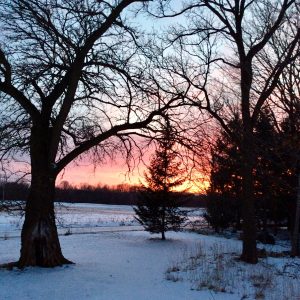
Free For the Taking

July is crunch time, the month that can make or break the season. So I try to keep everyone—myself included—on point and hustling, all of us working through that impossible to-do list. That’s as it should be: There’s no harvest without labor. But it’s all too easy to lose perspective in summer’s flurry of work, and when I need a little perspective, I like to take a walk out around the back of the property.

Our little farm sits on sixteen acres. On the front six are the house, barn, yard, and flower gardens. Behind them are maybe four acres for the greenhouses and orchard and vegetable plots. But further back are six acres not yet used, laying fallow. Those acres have been sown with a long-term cover crop—timothy, clover, alfalfa, and orchard grass—and I keep a path mowed around it for walking. So, last evening, that’s just what I did.

This time of year the grasses in the field nod in the warm breeze, their heads heavy with seed. The eastern and northern edges of the field I keep wild, and black cherries and flowering hawthorns like to grow there. In the spring sprout trout lilies bloom, and in the fall wild grapes hang heavy from the vines draped through the trees. Last evening, I found a patch of wild brambles I hadn’t noticed before, the berries already eaten by the birds.

Along the western edge of the farm I’m working to establish a wind break of white spruce and native crab apples. That’s also where I’ve set out some nest boxes for the bluebirds and tree sparrows. The sparrows seem to like them, but I haven’t seen any bluebirds take up residence yet. There must be a red-winged blackbird nest nearby, though—a pair hovered above my head, trilling and squawking me away.

And as I walked back toward the house in the growing twilight, the nearly-full moon rose bright and bold to the southeast, only slightly hazy in the thick summer air, and the fireflies began to drift in from the wild margins of the farm to hover and blink across the darkening yard.

It may be that there’s no harvest without labor, but beauty is free for the taking all around us, scattered by the fistsful.

Dividends Elsewhere

On the farm, there are urgent things, and there are important things. Sometimes these are the same things—staking and stringing the tomatoes, for example. And this time of year, the list of urgent things is long. The tricky list, though, is the set of things that are important but not urgent, things that could easily slide in the ferocity of the season.

The flower gardens, for example. Most of my farmer colleagues don’t grow ornamental flower beds. And when they visit our farm, they marvel that I have time to plant and maintain them. One of them mentioned to Shel that she feels like she’s so busy with the urgent business of farming that there’s no time to make things “look pretty.”

I suppose I could find arguments to justify the flower beds’ utility, how they attract pollinators or could be used to make bouquets to sell at market, but the truth simply is that they delight me and others, so I make it a priority to tend to them. I don’t quite see the point of having the farm be only about production and efficiency and work. It’s not like we’re making a killing in this vocation, so we might as well find our dividends elsewhere, in the beauty of the fields, in the generosity of the earth.

The Impossible Month

July is the impossible month.

For starters, we still have greenhouse work to keep up on. Not much, and not for much longer, but we need to seed crops like fall broccoli and kohlrabi, as well as successions of mini-cabbages and lettuces so that we have enough food for the CSA shares at the end of the season.

So that’s a few items on the to-do list.

And we are still transplanting. Though the main summer crops are all in the ground, we’re about to start planting the primary fall crops: fresh plantings of kale, plus collard greens, storage cabbages, cauliflower and more. Again, if we don’t keep up with these tasks, we run the risk of smaller shares in September and October.

A few more things on the list.

And we have to stay on top of the weeds. Granted, this becomes harder and harder the deeper we get into the season, and at a certain point the job becomes mainly triage, but we at least have to try. Otherwise, the weeds compete with the crops for sun and soil and rain, eventually choking them out.

This list is getting a little long.

And we have to monitor for pests and respond accordingly. The ones that showed up this week are the Colorado potato beetle and the cucumber beetle. The Colorado potato beetle infestation is small enough that we might be able to control it via manual control (a.k.a. smooshing them), but I will have to spray an organically-approved product for the cucumber beetles. Plus, I saw imported cabbage moths fluttering around the fields today, presumably laying their eggs. So a third infestation is waiting in the wings.

Three more items added to the list.

And we have to make time for maintenance tasks like driving tomato stakes and running irrigation lines (in the hope that someday it might stop raining).

Hold on a second while I set up this second chalkboard so I can fit the rest of the list.

Plus we’re harvesting two days a week, soon to be three, which is a joy and, really, the whole point of the enterprise, but, still, it takes time, which is in shorter and shorter supply even as the harvest docket grows longer. Plus there is tractor work for me to do to make sure we have fields prepared for the crops we are seeding and transplanting. Plus shopping for a new delivery vehicle for when the old farm truck finally gives up the ghost. Plus … well, I’m sure you get the gist.

July is the impossible month.

Perfect Day For Cultivating

One of the first things I’m asked when folks learn that I’m an organic farmer is, “What do you do about the weeds?” It’s a good question, something I even ask myself at times (sometimes phrased more like, “What the %^# am I going to do about these &+%#@$* weeds!?!)—especially this time of year, where ample soil moisture and warm temperatures provide weed seeds with a germination haven.

What I try to avoid is time-consuming hand weeding, though that is still necessary, sometimes. Rather, I aim to hit the weeds earlier, when they are smaller and easier to deal with, by cultivating them. Cultivating is a practice where you disturb only the top layer of soil, uprooting the tiny weed seedlings and leaving them to desiccate in the sun, while leaving the lower soil layers intact so as not to bring new weed seeds to the surface. I have an arsenal of tools for this job: small hand cultivators, long-handled hoes, an old-fashioned tool called a wheel hoe, and our noisy, bone-rattling rototiller. Someday, maybe, we’ll step up to a specialized and dedicated cultivating tractor, and then we’ll know we have arrived.

When cultivation works, it works brilliantly, and today was the perfect day for it—warm, dry, with a little wind—and the weeds were the ideal size. This afternoon the crew and I tacked the section of the field with our tomatoes, peppers, and eggplants (I call it Solanaceae Land), and the five of us covered every square inch of that 20,000 square foot plot. It looks so good right now I could dance a jig, if that was the sort of thing I did.

The Blackbird’s Call

Almost two weeks ago now, I heard the first trill of a red-winged blackbird perched high in the bare branched maple tree behind the house. “You best get to work, friend,” his call said. “Spring’s coming.”

And has it ever. Over just a couple of days, the snow cover melted from the farm in great rushing rivulets. Now that the ground is bare, I can see that the rye cover crop I sowed last fall survived the winter and soon will be putting on new growth to protect the soil during the April rains. I can see, too, that the trees are thinking about waking up, their buds swelling as the days grow longer and lighter. The migrating birds have already started arriving from their winter homes, and they fill the mornings with their song. Soon enough, the field will be draped in green, and the trees will burst with green, and the wide world will rejoice in its greenness. The sky will fill with clear light like bright water fills a glass, and I will fire up the old tractor and begin preparing the field for planting.

So it’s high time to blow the last of winter’s dust out of my mind and begin the work. It’s a good feeling, slipping back into the harness, pulling a load. Right now, most of the jobs are in the greenhouse, seeding the first of this season’s crops, but I also have a fair bit of errands to run, making sure all our supplies are laid in for the spring’s building and repairing and cleaning and tending. Falling into these rhythms of work is like the singing of a liturgy, of being borne forward upon deep waters of habit, of memory, of the ceaseless cycling of the seasons.

A Secret

In less than a week, once again I’ll dive into the cycle of the farming year. While outside the world will be cold and snow-covered, I’ll enter the warm, protected space of the greenhouse, breathe deep the scent of thawed earth, fill flats with potting soil, and begin seeding onions, leeks, and shallots.

It’s the first stage of a long journey: The greenhouse work intensifies as the weeks go by. Then, sometime in April (ideally), the ground dries out enough to begin fieldwork. May sees the beginning of transplanting. June finds us fighting the weeds. Come July, we harvest more and more. August is something of a crescendo, the point at which the trajectory of the season is set and we begin the ride to the end. September is all about the harvest, October brings frost, and November we put the farm to bed before the ground freezes and the winter snows fall again. One big glorious, beautiful, dramatic arc, reliably repeating year in and year out.

I’ll tell you a secret: Here, from February’s perspective, it never fails to look impossible. Impossibly complex. Impossibly difficult. Impossibly risky. Who again, I’ll ask myself, thought this was a good idea? But come that first Monday in March—I’ve done this now for a dozen years—I’ll eagerly sink my hands deep into that bag of potting soil, grateful for another turn of the wheel.

To Pause And Give Thanks

This past month has seen me readying the farm for winter—jobs like moving the hens to their coop, buttoning up the greenhouses, and cleaning and organizing the barn so everything is good to go for spring. In the midst of this winding down, I have already begun preparing for next season. The potting soil has arrived, and the seed potatoes will need to be ordered soon. Also on deck for December is drafting the seeding schedule and field plan, as well as calculating the 2019 budget.

But between those two sets of tasks, between clearing the remnants of the season just finished and laying the foundation for the one yet to come, rests a moment to pause and give thanks. As part of my end-of-season review, I have filled a page of my farm notebook listing everything I am thankful for this past season. And reviewing it, I see that in some ways I am thankful most for those things that didn’t happen.

Nothing broke down. I rely on a fair bit of equipment to keep the farm running smoothly—some of it, like the tractor and farm truck, quite elderly. And having one of those machines break down would have been, at the very least, a huge headache, as well as a major time suck and financial challenge. But everything kept chugging along, for which I am thankful.

We didn’t experience any catastrophic weather. On Instagram, I follow farms from all around the country, and many of those far-flung colleagues had some truly, biblically-catastrophic weather this season: Torrential rains in the Northeast. Unrelenting drought in the Southwest. Hurricanes, wildfires, floods. I know I tend to complain about the weather, as is the farmers’ ancient prerogative, but we were given seasonable weather this year, and I am grateful.

No one was seriously injured. Farming is dangerous. Here are a couple of fun facts: The fatality rate for farm workers is seven times higher than that of workers in all other private industries. (The leading cause of death, by the way, is being crushed under a tractor.) Each day, 243 farm workers are seriously injured, a rate 40 percent higher than the national average. And small operations like ours aren’t exempt. I vividly remember one time on another farm when one of the crew, as he was carelessly sharpening his harvest knife, deeply slit the inside of his left forearm from wrist to elbow. That was a scary day. I am so thankful nothing like that has happened here to any of our workers.

More than avoiding those bad scenarios, I am grateful for the many, many good things we received this season. Obviously, I am grateful for all the good things to eat that the farm yielded. And I am grateful, too, for this lovely place we’ve been given, and that I have the privilege of working and living here and the chance to share all this beauty and delight with others. But, above all, I am so grateful for our members, who make all this possible. None of this adventure would have been possible without them.