Crazy Cat Farm No More

At long last, we are getting the rest of the farm cats fixed. (You can read more about our crazy cat chronicles here.)

This task had been on my to-do list for a while, but I was not able to pull it off on my own. The scheduling of it all was the hitch, making time amid the busyness of the CSA season to trap and transport cats to the feral rescue organization. I had slated this spring to finally tackle the job, since I was expecting to have more time during our sabbatical year, but the pandemic struck, and everything shut down. Then the cats had litters of kittens, which required time to tame and adopt out. And then we were in the thick of the growing season.

Here’s what happened to turn the tide. Toward the end of August, Shel and I heard the sound of kittens. Which after a spring flood of kittens was awfully demoralizing. We looked around and found them—three little ones—under the front porch steps. But mama cat was nowhere to be found. We waited a while to see if she would show. She didn’t. The kittens were tiny and shivering and crying. What to do?

When we had the spring litters, Kolleen, a friend of mine, told me that she was involved in cat and kitten rescue over on the lakeshore, and that if I ever ran into trouble, I should give her a call. Well, I reckoned this counted as trouble, so I texted her.

She phoned back right away and asked if I was sure the mama cat had abandoned them. I described how long they had been crying, and how they were starting to crawl from their hiding place under the porch, even though their eyes weren’t even open yet.

“Oh, that’s bad,” she said. “Hang tight while I make some calls.”

Almost immediately, I got a text: “This is Angela. Call me about the kittens.”

So I called. She spoke swiftly, and with authority: Get the kittens. Put them in a box with a warm blanket. Meet her in twenty minutes in the parking lot of the Norton Shores Target.

I gathered up the tender little fluff balls, put them in a small box with a fuzzy towel, and made the drive. When I handed Angela the kittens, she handed me a live trap. “Get the mom,” she said. “We’ll get her fixed.”

Well. Clearly I had found the ally I needed to solve the farm’s cat problem.

Once I returned to the farm, mama cat was hanging out on the farmhouse porch, utterly unconcerned that all her babies went missing. Seeing this was my chance, I baited the trap and set it out. Sure enough, once I went inside, she sniffed around it, then went right inside. The trap banged shut. Victory.

I texted Angela: “Good news: Mama cat is in the trap.”

Angela texted back: “Meet me in ten minutes at Turk’s Tavern.”

So I did. When I handed off mama cat. Angela explained that she would try to reunite her with the kittens, and then get her fixed.

That’s how it started. Once mama cat returned to the farm, I trapped the others that still needed to be fixed—Ninja and Medium, Puffball and Scruffy—and Angela helped take them to the clinic. Now, only one cat remains, a big fighting tom, scarred and wary. We call him Socks because of his white feet and shins. So far he has resisted the trap. But I will keep trying, at least until the snow flies.
My Favorite Turn of the Season

Here at the farm, we’re on the back half of the season now for certain. All the signs are here: the trees along the edges of the field turning red and orange and yellow, the Great Bear in the evening darkness dipping lower toward the horizon, the farm cats spending less time hunting field mice and more curled up on blankets in the house, the sumac catching fiery red, the cool green freshness of the fall crops reaching maturity. It’s my favorite turn of the season, and with it my mind also turns toward next year.

Which is, as you well know, full of uncertainty, given all that’s going on in the world. Planting the farm’s garlic crop this week, I found myself wondering, What will the world look like when these little cloves are pushing their tender green shoots through the straw mulch this coming spring? Who can say? But in the same way the cycle of the seasons keeps on turning, the farm work moves along its well-worn path, and I follow it, in faith and hope.

One more thing: This fallow season has reminded me how grateful I am to be able to farm, and how grateful I am for all the support of our members over these past seven seasons. From the bottom of my heart: thank you. I am looking forward to growing food for you and yours next season, and for many seasons to come.

Blackbird Farms Spring Plant Sale Dates and Online Ordering

After a bitterly cold weekend, it looks like more seasonable weather is coming our way this week, which means here at the farm we will busy ourselves with spring planting. And considering the overwhelming mania for home gardening right now, you might be thinking about that as well.

I’m all for this mania for these pandemic gardens or quarantine gardens or doomsday gardens—though I like best calling them the new victory gardens. Realistically, maybe you can’t completely feed your family from backyard gardening, but it sure seems to me like a great way to spend some of this anxious energy and extra time many of us now have on our hands. So I wish all of you gardeners success and bounty this season.

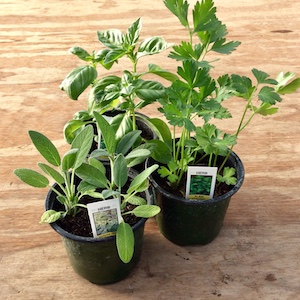
And if you or someone you know is eager to garden this season but not eager to brave the stores or farmers markets to purchase herb and vegetable plants, we’re offering online ordering, with a number of no-contact/low-contact curbside/barnside pick-up options over the next few weeks.

Here are the ordering details: Each Sunday in May, we will update our order form (see below for link) for the pick-ups occurring that week. (Yes, I am afraid that means that you cannot order too far in advance—only for the current week.) Note that the inventory will likely change from week to week, depending on what we have in stock. If an item sells out in any particular week, it will be removed from the form. New stock may be available the following week.

Here is the online order form: https://forms.gle/SznJrmb57kk26SdS6. Orders are due by 10:00 am on the day prior to the pick-up.

Here is the list of upcoming pick-up dates and locations:
–Friday, May 15, 4:00-6:00 pm at Blackbird Farms (5213 Roosevelt, Coopersville, MI 49404)
–Saturday, May 16, 10:00-11:00 am at the Sweetwater Local Foods Market (6401 Harvey, Norton Shores, MI 49444)

–Wednesday, May 20, 5:00-7:00 pm: DBC Natural Holistic Health Center (2851 Michigan NE, Grand Rapids, MI 49506)
–Thursday, May 21, 4:00-8:00 pm: Blackbird Farms
–Saturday, May 23, 10:00-11:00 am: Sweetwater Local Foods Market

–Friday, May 29, 4:00-6:00 pm: Blackbird Farms
–Saturday, May 30, 10:00-11:00 am: Sweetwater Local Foods Market

–(tentative) Saturday, June 6, 10:00-11:00 am: Sweetwater Local Foods Market

Please don’t hesitate to reach out if you have any questions.

We are looking forward to helping both new and experienced home gardeners get off to a good start this growing season!

How To Do Things: Fertilize Organically

A good time to add amendments to your garden soil is when you are preparing your beds for spring. Loosening and aerating the soil while incorporating amendments mixes everything together well, knocking off two tasks at once.

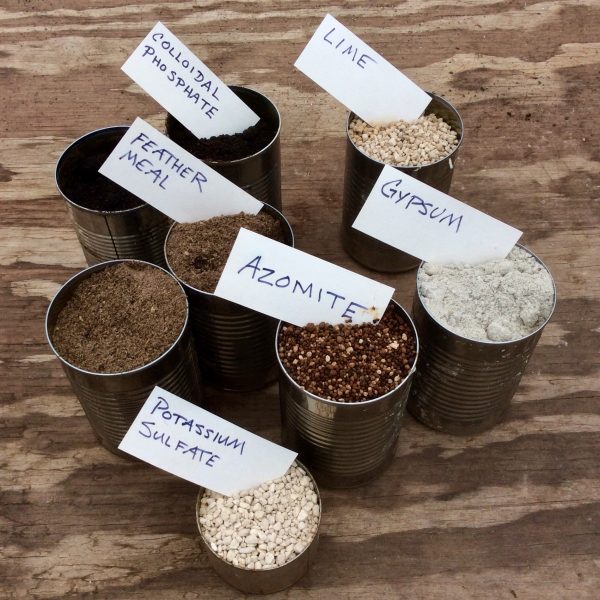
But what sort of amendments should you add? Short of taking a soil sample and sending it in for a complete analysis and set of recommendations (which is what we do here at the farm), the best solution I have found for the home gardener is to utilize the recipe for Steve Solomon’s “Complete Organic Fertilizer,” taken from his book The Intelligent Gardener.

On the up side, the recipe is adaptable, and it provides a nice range of nutrients. The down side is that some of the ingredients might take a little looking to find. (I have found them at various co-ops and agricultural supply stores, but I’ve never looked to see if they’re stocked at local garden centers.)

What about compost, you might ask. Yup, use that, too—it’s going to add organic matter and improve your soil’s texture, as well as provide some nutrients. But to ensure your plants are getting the full profile of what they need, I think it’s best to fortify your compost application with the sort of amendments Solomon’s recipe provides.

The New Victory Gardens

Maybe you’ve heard how the pandemic has inspired folks to put in gardens this season. Maybe you’re even one of those so inspired. Some have named these “Doomsday Gardens,” which is a little dark for me—I much prefer “New Victory Gardens,” after the old victory gardens from another national crisis, the Second World War.

I’m assuming many who are planting these gardens are newbies, which I think is great, and I wish them all success this season. But there’s a steep learning curve, and I hope they don’t get discouraged when things go awry. (And in a garden something always goes awry.)

And as a primer for how to get started, I came across a great little article in the Washington Post that walks through all the basics, plus offers a few additional resources. I’m going to strive over the course of the season to post good resources here as well. So godspeed you, newbies, and remember: The best fertilizer is the footsteps of the gardener.

How To Do Things: Growing Green Garlic

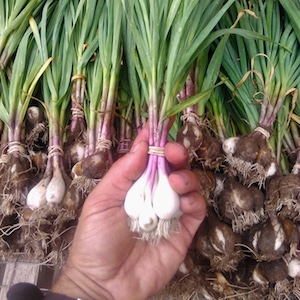
One of the earlier—and perhaps more unfamiliar—crops you can plant in your vegetable garden is green garlic, sometimes also called spring garlic.

Green garlic is simply immature garlic plants harvested early (April to May here in zone 6a), when they are about the diameter of a pencil. Bon Appetit states that “the immature garlic bulbs and edible green stalks have an amazing nutty-oniony flavor that is great fresh or cooked,” and who am I to argue with Bon Appetit? Use them wherever you would use onions, scallions, or leeks.

On the farm, I have found that green garlic is a great way to utilize the smallest garlic heads (around here called dinkers, or dinks, or el dinkerinos when we’re not into the whole brevity thing), heads that are not suitable for seed, for distribution through the CSA, or for sale at farmers’ market, and that would otherwise go to waste. I imagine it would also be a good way to use up heads in the root cellar in late spring that are about to or already have sprouted. For the home grower, most any variety of garlic will work for green garlic, though do be wary of conventionally grown garlic heads. These are often sprayed with a chemical to inhibit their sprouting and won’t grow when planted, so be sure to stick with stuff that’s organically grown.

For earliest farmers’ market sales, I will plant the cloves in mid- to late fall, the same time as the garlic I grow for mature heads. If I am planning to distribute the green garlic through the CSA, however, I will plant in the spring as soon as the soil can be worked, which makes sure they are ready to be harvested the first weeks of June. So it’s not too late for you to plant green garlic in your garden right now.

When planting, I simply put the whole head of garlic in the ground, root end down, about two inches deep and six inches apart, in four rows also about six inches apart. (This is the same spacing I use for the rest of the garlic.) You can certainly tighten this plant spacing, up to three inch spacing in rows three inches apart. I plant whole heads so I can harvest them in market-ready bunches, thus saving time, but you might find it more convenient to harvest the green garlic a single plant or two at a time. In that case, break the head apart into individual cloves (a process called “popping”) and plant each one root end down, pointy end up, at the depth and spacing discussed above.

Green garlic is delicious, and a welcome vegetable at a time when green things for the table can be scarce. I hope you will give growing it a shot. Happy gardening!

Work Is Balm

I am struggling to find something to say in this moment. I want to write something true and urgent and inspiring. I would like to write that I am rising to the occasion—the heroic farmer, toiling on in the teeth of the plague.

The truth is, like everyone else, I am muddling through. Trying to get my work done. Trying to be resilient and generous and cheerful. Sometimes, even succeeding.

Luckily, the farm work is always there. Though the state has been in lockdown since Tuesday before last, farmers are considered essential personnel, so our work will go on apace. I was about to write that it will go on without hindrance, but that clearly will not be the case. Since January I have had all the supplies I will need to get the season going, but what it will take to keep the season going remains to be seen. But pandemic or no, my calling is to grow food for people. So that is what I am going to do, for as long as I can do it.

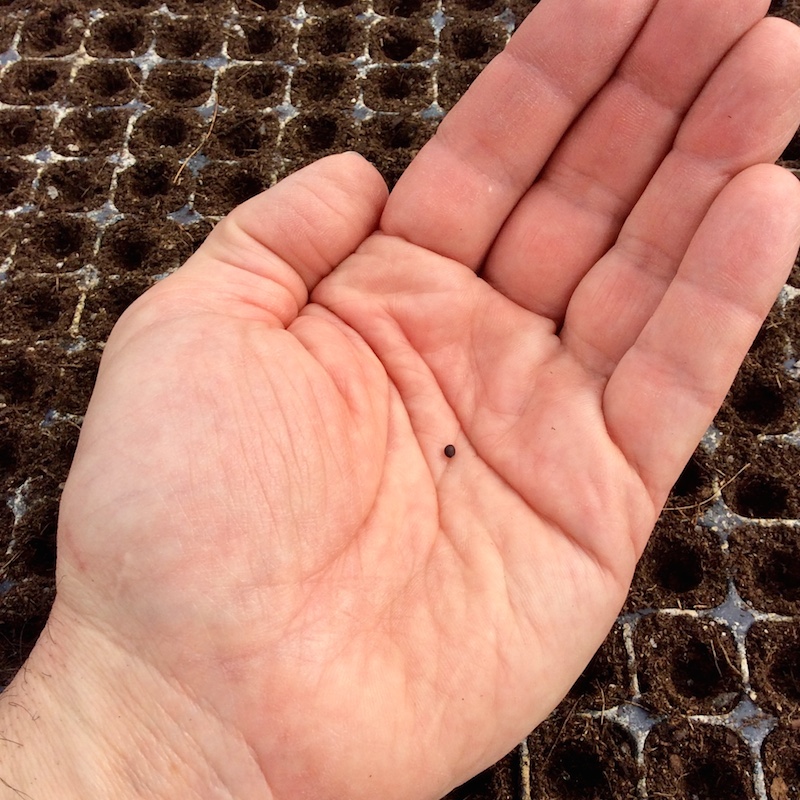
To be honest, thinking about farming through this crisis can be overwhelming. But a curious thing: When I stop thinking about the work and start doing the work, actually sinking my hands into the potting soil, pressing the little seeds into nursery flats, rooting cuttings, sprouting rhizomes—all the jobs required to make the springtime farm go—my troubled mind settles into the rhythm of the day’s work, and I am better.

The work is a balm. It gets me out of my head and into the world. That’s an old, old remedy, of course, at least as old as the fourth century, and I am grateful for it. May you find it too.