A Significant Threshold

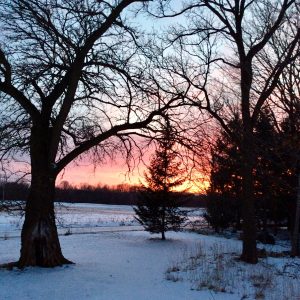
We had our first hard frost here at the farm early last Thursday morning—late in coming this season, and many of the crops it would have killed were already finished, so practically it made little difference. But mentally that first fall frost is always a significant threshold for me, a sign that our long adventure is nearly at its end.

All this month we have been readying the farm for winter. Partly that involves bringing in all the “hardware” from the field—tasks like unstringing the tomatoes and pulling our their stakes; dismantling, draining, and storing the irrigation system; and winding up the electric deer fence. And partly it means taking care of the field itself. As each section cycles out of production, I mow off what remains with the tractor’s brush mower (a deeply satisfying job), then disc the residue back into the soil. Finally, I sow a cover crop of rye over the now bare soil. Once the rye has germinated and started growing, it will help protect the soil over the winter and early spring.

Much of that work is finished now. There are a handful of lines of drip tape to be wound up, some row cover to be put away, and a couple of sections of the field waiting to be sown in cover crop before it rains next week. Only a few beds of cold-hardy vegetables remain standing. Otherwise, the field is at rest, peaceful and green, patiently waiting.

One Last Critical Task

When people ask about my favorite vegetable, I often say it’s garlic. It asks for so little, and gives so much. Almost all I need to do for a good harvest is plant it in a well-drained part of the field amended with aged bedding from the winter chicken coop and mulch it deeply with straw. I also really like the whole process of growing garlic: seeing it thrust through the soil and announcing the arrival of spring, trimming off the curlicue scapes in June, filling the loft of the barn with garlic plants laid out to cure, selecting and improving the seed garlic, and, finally, planting next season’s crop here at the end of October in defiance of the coming winter.

As our veteran members know, one of our garlic varieties—the one with the purple splotches on the outside of its papers—is a variety handed down through my family for five generations. For the past few years, I’ve been slowly improving my seed stock, and to good effect. The heads are now larger and the cloves more numerous compared to the original ones my mother gave me six years ago. I’ve now decided to give this strain a proper name: Anna Barbara’s Ohio Red, in honor of my great-great-great-grandmother.

We’re just about ready to start planting next season’s crop, either this week or the next. The crew is nearly finished with breaking the garlic down into cloves, a process called popping the heads, and the soil is drying out enough for me to start thinking about preparing beds to plant them in. Once the soil is ready, we can plant the cloves, spread the chicken manure, mulch the beds, and, then, with the last critical task of the season finished, take a deep breath and brace for winter.

Ragged

To tell the truth, October on the farm is a ragged month. Don’t get me wrong: closing in on the end of the season after seven months of intense work is surely satisfying, as is seeing the yields of all that work packed into the CSA boxes week after week. But eventually everything shows the strain. Now is when farms often experience equipment breakdowns and employee meltdowns (thankfully, neither have happened here this season), and now is when I really begin to feel the weight of the season in my body, all those accumulated stresses and strains manifesting in various repetitive stress injuries. Sometimes it shows up in my wrists, and sometimes my shoulders. This season, it’s in my feet, likely plantar fasciitis, so a post-season trip to the doctor is on the docket, with ibuprofen and ice in the meantime. Which is fine: I chose this vocation, so I won’t complain. But I will say that I don’t know how those farmers who do year-round CSAs are able to pull it off while keeping their bodies, minds, sanity, and marriages intact. There’s something good and true about embracing the rhythm of the season, from the eagerness and energy of spring, the madness and bounty of summer, the weariness and satisfaction of fall, and finally the rest and regeneration of winter, and then on again through the cycle, a steady and reliable wheel, rolling on down though the years.

Home Stretch

And we’re in the home stretch, the final quarter of the CSA season. We spend the balance of our time harvesting now. Last week we brought in most of the winter squash from the fields and set them in the greenhouse to cure a while before distribution, and on Monday we dug up the rest of the potatoes. The squash was a bumper crop. The potatoes, not so much. Which is the way it goes, sometimes.

When we’re not harvesting, we’re readying the farm for winter. As parts of the field are finished for the season, we wind up the drip tape, mow off the plants, and disc in the residue, which helps build up organic matter in the soil. Then, to protect the soil over the winter, I broadcast a cover crop of rye seed. Yesterday I did this process to the part of the field where the spring crops and potatoes were, and it felt good to clean up that area and set it aside in my mind.

And in off moments, I’m starting to ponder and dream about next season—new varieties to grow, new techniques to try, new tools to research, and more ways to make this place more beautiful and bountiful. And, most of all, I’m pondering and dreaming about the rest, recovery, and rejuvenation to come once the snow finally flies.

The Season By Thirds

If you like, you can divvy up the farm’s season into three parts. The theme of the first third (March, April, and May) is preparation—anticipation, even. Those months are all about getting ready: gathering seeds and soil, hiring a crew, starting plants in the greenhouse, preparing the field for planting. For those three months, the farm is mostly potential and full of promise. The farm never looks so good as it does in my mind’s eye during that time.

The middle third—June, July, and August—is all about resilience. That plan so carefully prepared in the first part of the season never entirely holds together as the work unfolds in those months. And what a lot of work is to be done! Everything is happening, all at once, and the whole crew needs to be swift and nimble to get it all done.

And the last third, which we soon enter, is about one thing only: endurance. Almost all our time now will be spent harvesting, first the fruits of high summer, then later the bounty of fall. We’ll push through the heat and humidity, then through the cold and rain. We’ll push through the accumulated aches and pains, and we’ll push through our declining energy. Two more months of concentrated effort, then a slower, more easeful month of putting the farm to bed for winter, then rest, and dreams of spring.

One Eye On the Fields, One On the Clock

It’s crunch time. More than usual, I mean. As I’ve mentioned here before, there are so many tasks that really need to be done before the first part of August (I’ve decided, only partly arbitrarily, that August 7 is the date this season), after which our window for effective action rapidly begins to close. If the tomatoes aren’t strung now, beginning to string them then won’t help. If the organic fertilizers and soil amendments the plants need aren’t spread now, starting to apply them then won’t make much of a difference. If certain vegetables aren’t transplanted or seeded now, they won’t have enough time to come to maturity before the end of the season. And if a particular crop isn’t weeded now, better to mow it down and plant something else, or even sow a cover crop, than try to rescue and reap a harvest from it. Late August can be a time of hard choices, is what I’m saying—or, at best, a time of letting go, of accepting what is as the best that could be done under the circumstances of the season.

But we’re not at that point. Not yet. And the longer I farm, the more I know where and when to apply my resources to maximum effect. Hard work intelligently applied now can still bring great benefits the second half of the season. So we’re working hard, with purpose and urgency, one eye on the fields, and one on the clock, making the most of this time that we can.

Blackbird Farms Is Now Crazy Cat Farm

This week I thought I would interrupt our regularly scheduled program of vegetable updates and agrarian musings for an update on what around here we’ve come to call the Blackbird Farms Crazy Cat Show. (Really, sometimes I feel like I’m running a cat farm with a vegetable operation on the side.)

This all started back when we moved here five summers ago and realized that the previous owners almost certainly abandoned all their cats when they left the house. Our first night in the farmhouse, sure enough, there was an orange tabby outside the slider ready to be let back in. And as the days and weeks went by, we saw more and more cats lurking and lounging and skulking and stalking here and there about the property—I think we counted somewhere north of a dozen. Not wanting a dozen to become five dozen, I spent that fall trapping cats and delivering them for neutering to Carol’s Ferals. Friends would happen to call me while I was picking up or dropping off a load of trapped cats and hear all that howling and yowling in the background and think—well, I’m not sure what they thought. Those were awkward conversations. That was a weird month.

Since then those original cats have been replaced by others, who either find their way here on their own or are dropped off by others. (If this is you, please stop it.) Which means I need to spend another month trapping cats. It was on the to-do list early this spring before the season got in full swing, but it didn’t happen. I’m too busy now, so I’m hoping to get to it late this fall after things wind down. Because we, again, have something of a cat problem.

One of the main culprits is a black and grey tabby we’ve named Bandit. She bears litters of kittens pretty reliably, and many of the cats around here are hers. One of her daughters we call Ninja, because she is small and grey and fast and really good at darting into the house (where she does not belong) and then disappearing. She had a litter of kittens less than a month ago, her first, all grey just like her. She stashed them in a little cubby under the porch right by the back door, and they cry and cry every time we come or go.

And then there’s Old Man Cat. He’s been on the margins of the farm since we moved here, but this season for some reason he decided to adopt us. He hacks and sneezes and drools when he sleeps, and he has open sores behind his ears that won’t heal because he keeps scratching them. And I’ve never known a needier cat. Always wanting to be near you, to be petted, to be picked up. He waits for you to return home, right by the driveway, or sometimes right in the middle of the driveway, and won’t move, even if you honk your horn at him. And if you come for a visit and leave your car window down or truck door open, why he’ll just hop right in like he owns it and curl up on the floor and take a nap.

Anyway, we’re growing vegetables, too. It’s going well, though it’s awfully dry and we could really use some rain. But if it never rains again (sometimes that’s how it feels), and all the vegetables shrivel and die, I guess we could always put a kitten in each of the shares.